
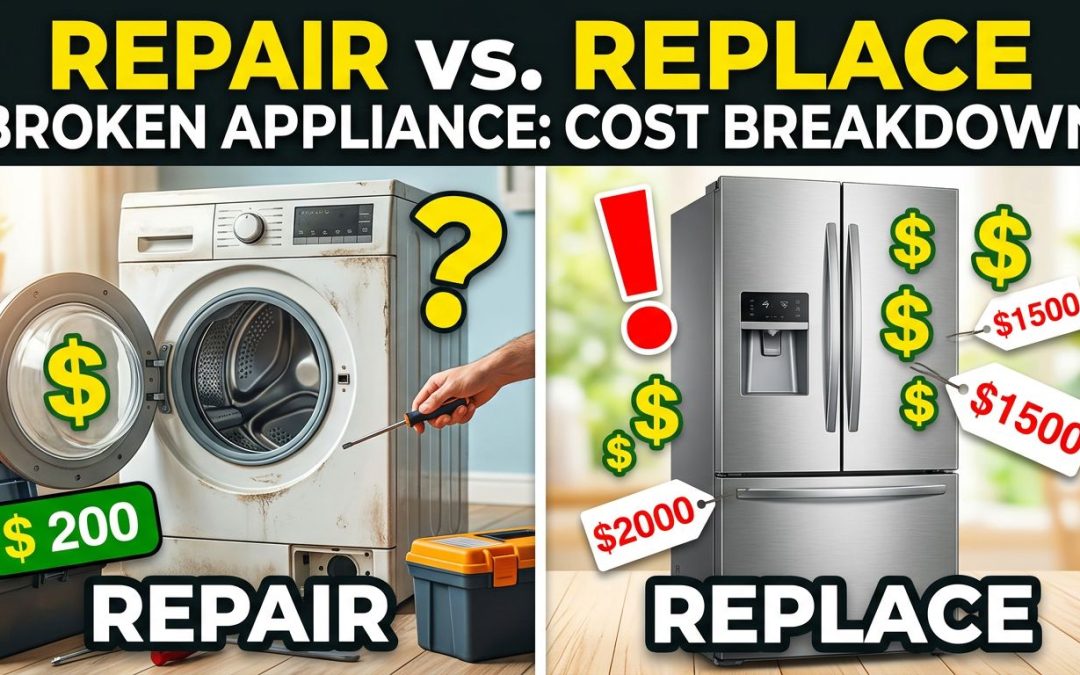
Your appliance just quit, and now you’re standing in front of it wondering whether to call a repair tech or drive to the nearest home improvement store. This guide breaks down exactly how to make that call with real numbers, honest trade-offs, and a straightforward framework you can use for any appliance in your home. Appliances don’t break at convenient times. They quit on a Sunday evening, or right before guests arrive, or in the middle of a rainy Maple Ridge winter when the last thing you want is an excuse to leave the house. At Simplyfix, we field these calls constantly homeowners who aren’t sure whether they’re looking at a $200 fix or a $1,500 replacement, and who just want someone to give them a straight answer. The good news is that this decision isn’t as complicated as it feels in the moment. There’s a simple framework that covers most situations, and once you understand the variables, you’ll be able to size up almost any broken appliance in about ten minutes.
Key takeaways
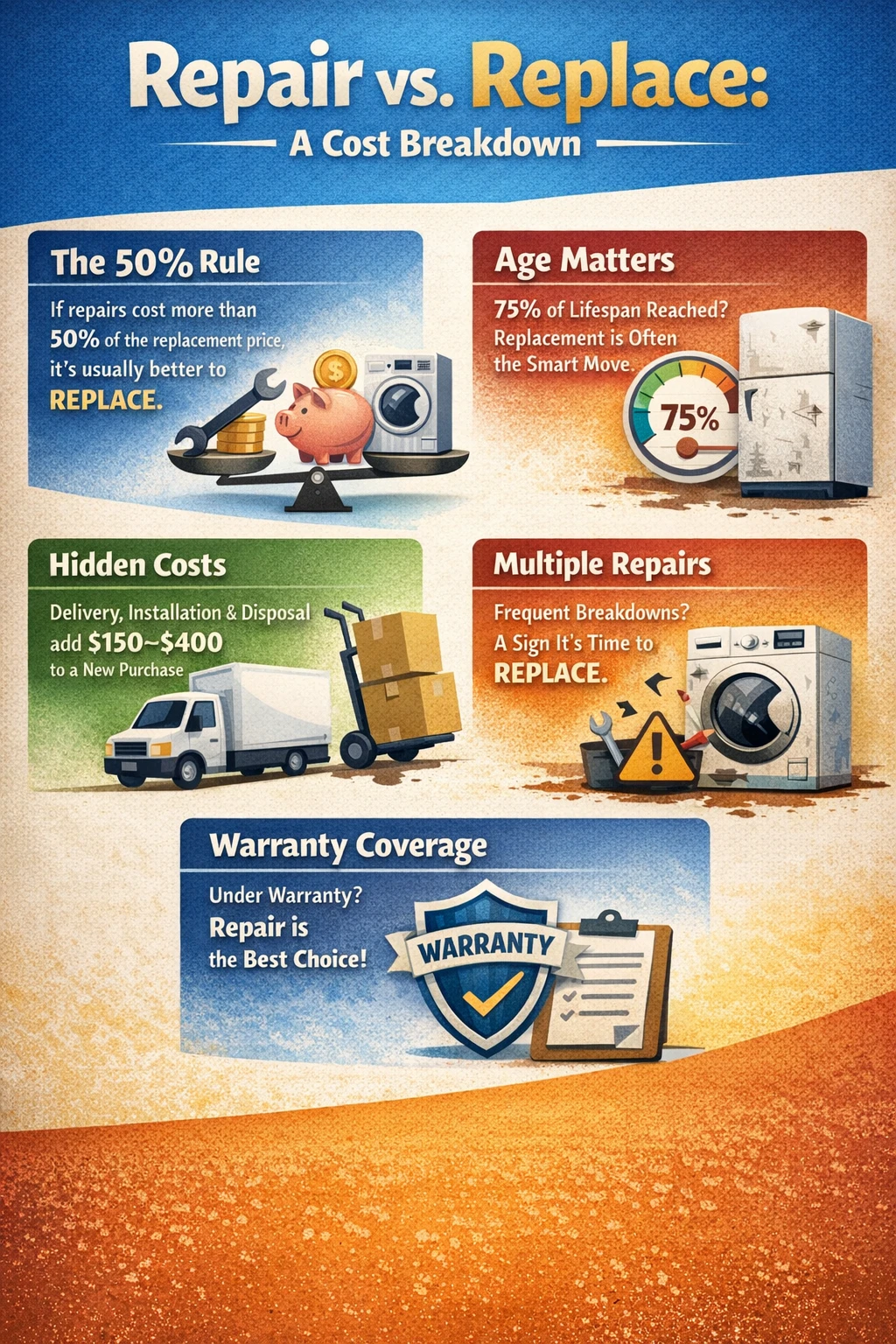
- If the repair cost is less than 50% of the price of a comparable replacement, repair is usually the smarter financial move.
- Appliance age matters a lot most major appliances have useful lifespans between 8 and 15 years, and repairs on units past that window rarely pay off.
- Replacement costs aren’t just the sticker price delivery, installation, hookup upgrades, and old-unit disposal can add $150 to $400 or more to the total.
- An appliance that was working well right up until it broke is a much better repair candidate than one that’s been struggling for months.
- Parts availability is often the deciding factor on older machines if the part doesn’t exist anymore, the decision makes itself.
- Appliances under warranty should almost always be repaired, not replaced, since the manufacturer covers the cost.
The repair vs replace decision: how to think about it
The most useful starting point is the 50% rule: if repairing your appliance will cost more than half the price of buying a comparable replacement, you’re usually better off replacing it. That’s the baseline. If the repair is well under that threshold and the machine is in reasonable shape, fix it and move on. But the 50% rule is a floor, not a ceiling. You also have to factor in age. A more refined version is the 50/75 rule: repair makes sense if the cost is under 50% of replacement AND the appliance is under 75% of its expected lifespan. So a washing machine with a 12-year typical lifespan is a good repair candidate if it’s under 9 years old. Once it passes that 75% mark, you’re patching something that’s running out of road. In our experience, homeowners tend to underestimate what a new appliance actually costs all-in. The sticker price is just the beginning. Add delivery, professional installation, potential wiring or hookup upgrades if the new unit has different requirements, and disposal of the old one and that $700 dishwasher can easily become a $950 purchase. Factor all of that into your comparison before you decide. 
Average appliance lifespans: knowing where you stand
Before you can apply any rule of thumb, you need to know how old your appliance is relative to its expected lifespan. Here’s a general guide based on industry data and what we commonly see in homes across Maple Ridge:
- Washing machine: 10-14 years
- Dryer: 10-13 years
- Refrigerator: 10-15 years
- Dishwasher: 9-15 years
- Oven or range: 13-17 years
- Microwave: 7-10 years
- Garbage disposal: 5-12 years
- Water heater: 8-12 years
These ranges assume reasonable maintenance. High-end brands tend to land at the top of the range; budget models often fall short of it. A washing machine from a premium manufacturer that’s been cleaned and serviced regularly might run 14 or 15 years without a major problem. The same machine from a bargain brand, run hard with no maintenance, might start causing trouble at 7 or 8. Older homes in areas like Thornhill and Cottonwood often have appliances that were installed before a renovation and haven’t been touched since. If you’re not sure when your appliances were purchased, check the serial number most manufacturers encode the production date in it, and a quick search online will tell you exactly how old the unit is. 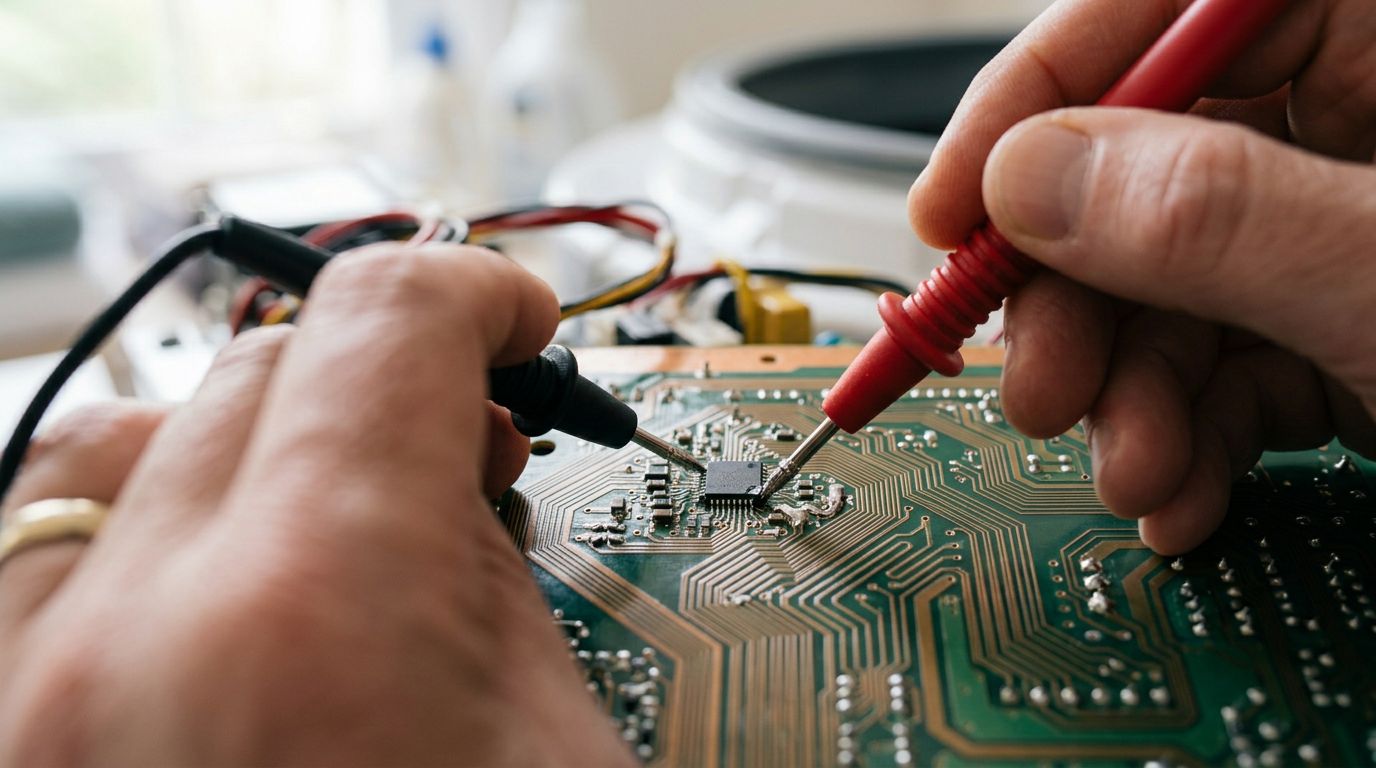
When repair almost always makes sense
Some situations are clear. If the appliance is relatively new, still under warranty, and has been performing well, repairing it is almost always the right call. The manufacturer covers the cost if it’s under warranty, and a newer machine with a clean history has plenty of life left. Same logic applies when the problem is minor and isolated. A fridge with a worn door gasket, a dryer with a broken belt, an oven that needs a new igniter these are single-component fixes. The rest of the machine is fine. In those cases, you’re not repairing a sick appliance; you’re replacing one worn part so a healthy machine can keep running. Control boards are the exception worth flagging. They’re expensive, sometimes running $200 to $400 or more for the part alone, and they’re often proprietary to a specific model. If a control board fails on a 10-year-old appliance, that single repair can hit 60 or 70% of replacement cost fast. That’s a case where the 50% rule genuinely saves you from overpaying for a repair that doesn’t make financial sense. One thing that often tips the scales toward repair: parts availability. We get calls about this all the time. If you have an older but reliable machine and the part you need is still being made, repairing it can absolutely be worth it. If the part is discontinued or has to be sourced from overseas with a 6-week wait, that changes the picture considerably. 
When replacement is the smarter move
There are a few situations where replacement wins, even if the repair quote seems manageable on its own. The clearest one: the appliance has been struggling before it broke. A washing machine that’s been leaving clothes damp, a fridge that’s been running constantly to hold temperature, a dishwasher that takes two cycles to actually clean anything. If you repair the presenting problem, you haven’t fixed the underlying decline. You’ve spent $300 to get a machine that was already underperforming. Repeated repairs are the other red flag. One repair in five years is normal. Two or three repairs in the last 18 months, on the same machine, is a pattern. At that point you’re not fixing an appliance you’re subsidizing one that’s near the end of its useful life. Some homeowners keep pouring money into a machine because each individual repair seems reasonable. Add them up and the picture changes. Refrigerant systems deserve their own mention. Fridge or freezer compressor failures are expensive often $400 to $600 for the part alone. If the compressor goes on a fridge that’s 10 years old or older, replacement almost always wins. The compressor is the heart of the system, and if it’s failing, other components aren’t far behind. The math rarely works out in favor of repair at that point. Water-involved failures are also worth treating seriously. An appliance that’s actively leaking deserves careful evaluation before you commit to repair, especially if the leak has been ongoing. Water damage to flooring or cabinetry can cost far more than the appliance itself. Nobody wants to come home to a flooded laundry room.
Appliance-by-appliance: what we typically see
Washers and dryers
These are among the most repair-friendly appliances in the house. Motors, belts, pumps, door latches, heating elements most of these parts are available, reasonably priced, and not too difficult to replace. Dryer heating elements in particular are a classic example of a repair that costs $50 to $100 in parts and takes an hour. It’s almost always worth doing. Drum bearing replacement on a front-load washer is more labor-intensive and can push toward the 50% threshold quickly. That one requires more careful math. For washer repair in Maple Ridge, the decision usually comes down to age and the nature of the failure simple parts versus complex teardown.
Refrigerators
Fridges are worth repairing in most cases if they’re under 10 years old and the problem isn’t a compressor. Defrost system issues, thermostat failures, ice maker problems, fan motors all of these are manageable repairs. The compressor is the exception. A $500 part on an aging fridge almost never pencils out. Fridge repair in Maple Ridge follows the same logic: newer and a non-compressor issue, fix it. Old and compressor-related, start shopping.
Dishwashers
Dishwashers sit in an interesting middle ground. They’re not that expensive to replace (many solid units are available in the $400 to $700 range), but they’re also not that complicated to fix. Door gasket leaks, pump failures, spray arm issues these are usually inexpensive repairs. If a dishwasher is under 7 or 8 years old and the problem is isolated, repair is almost always worthwhile. Past 12 years, the calculation gets harder.
Ovens and ranges
Ovens and ranges tend to have long useful lives, often 15 years or more. An igniter replacement on a gas range is a classic example of a repair that makes obvious sense it’s a $30 to $80 part and the fix is straightforward. Even on older units like a 15 or 18-year-old Kenmore Elite, a repair like that can be worth doing if the rest of the range is in good shape. Rust inside the oven cavity is a different story that’s expensive to address and usually a sign to replace. Control board failures on modern ranges, as with washers, can be costly enough to push past the 50% threshold, especially on mid-range appliances. Oven and stove repair in Maple Ridge is something we see regularly, and the age-plus-repair-cost formula holds here as reliably as anywhere.
Smaller appliances
Microwaves, range hoods, bathroom fans, and garbage disposals follow simpler rules. These are lower-cost appliances to begin with, so the bar for repair is lower. A garbage disposal that’s 5 years old with a jammed plate might just need a reset literally a 30-second fix. One that’s 10 years old and making grinding noises probably needs replacing, and replacements start around $100 to $150 for a basic unit. Range hood repair usually comes down to the fan motor or the filters. If the motor goes on a hood that’s still in good shape cosmetically, repair usually wins. Bathroom fan repair is similar motors are inexpensive and the fans themselves are simple enough that repair is worth attempting before replacement.
DIY versus calling a professional
Some repairs are genuinely low-risk DIY projects. Replacing a dryer belt, unclogging a dishwasher drain pump, swapping a fridge water filter, cleaning condenser coils, or replacing a washing machine inlet valve these are documented in detail on YouTube and parts sites, and a confident homeowner with basic tools can handle them. The savings can be real. A repair that costs $200 in labor might cost $40 in parts if you do it yourself. Anything involving gas lines, electrical rewiring, or refrigerant systems is a different category. These aren’t just hard they carry genuine safety risk if done incorrectly. Gas stove and range repairs involving the gas supply should go to a professional. Anything that requires evacuating or recharging a refrigerant system requires specialized equipment and, in Canada, proper certification. Don’t improvise on these. One thing worth knowing: the average professional appliance repair call runs around $150 to $250 including parts and labor for straightforward jobs. Some companies charge a diagnostic fee upfront (often $60 to $100) that gets credited toward the repair if you proceed. Get that confirmed before the tech shows up. If you can find appliance repair near you in Maple Ridge with transparent flat-rate or credited-diagnostic pricing, that takes the guesswork out of the first step. For recalls, check Health Canada’s recall database or the U.S. Consumer Product Safety Commission both track appliance recalls that may entitle you to a free repair or replacement. It’s a quick check and worth doing before you pay for a repair on a machine that the manufacturer is already obligated to fix.
Energy efficiency: does it actually change the math?
Sometimes, yes. Newer appliances particularly refrigerators, washers, and dishwashers have gotten meaningfully more efficient over the past decade. An older fridge can use roughly twice the electricity of a current ENERGY STAR model. Over several years, that difference in utility cost can offset part of the replacement price. That said, don’t let efficiency projections talk you into a replacement that doesn’t otherwise make sense. The efficiency argument works best when the appliance is already old enough to replace, and the energy savings are a secondary benefit that makes the decision easier. If you’re using efficiency as the primary justification to replace a 6-year-old appliance that just needs a $150 repair, the math probably doesn’t support it. Homes in newer developments around Silver Valley tend to have more recently installed appliances and won’t see as much efficiency gain from upgrading. Older homes with original appliances from the 1990s or early 2000s are the cases where efficiency savings can genuinely tip the scales. For those homeowners, the Natural Resources Canada ENERGUIDE program has useful information on appliance efficiency ratings that can help with the comparison.
Frequently asked questions
Making the repair-versus-replace call gets easier once you’ve thought through the framework, but a few questions come up again and again. Here are the ones we hear most often.
What is the 50% rule for appliance repair?
The 50% rule says that if a repair will cost 50% or more of the price of a comparable new appliance, replacement is usually the better financial decision. So if a new washing machine costs $700, a repair that quotes at $350 or more is the point where you should seriously consider replacing instead. This rule works best as a starting point you still need to factor in the appliance’s age, its overall condition, and whether the repair addresses the core problem or just one symptom of broader decline.
How do I know if my appliance is too old to repair?
Check the manufacture date (usually in the serial number) and compare it to typical lifespan ranges for that appliance type. If you’re past 75% to 80% of the expected lifespan, repairs become progressively harder to justify. A 13-year-old fridge might still have some years left if it’s been reliable, but if it needs a significant repair at that age, you’re likely just delaying the inevitable. The honest question is: how much total life do I realistically have left on this machine, and is the repair cost worth it given that remaining window?
Should I repair or replace if my appliance keeps breaking down?
Multiple repairs in a short time window is a signal to stop and look at the pattern, not just the current repair. If you’ve put money into the same machine two or three times in the past couple of years, you’re probably past the point where individual repairs make sense. Add up what you’ve spent over the last 24 months and compare that to replacement cost the answer usually becomes obvious when you see the total.
Are newer appliances actually more reliable than older ones?
This one is genuinely mixed. Newer appliances are almost always more energy-efficient, but reliability is a separate question. Some older machines, particularly those from the 1980s and 1990s, were built with simpler mechanical systems that are easier to repair and can last for decades. Modern appliances often have more electronics, which can mean more failure points and more expensive control board replacements. A well-maintained 20-year-old washer with a simple agitator mechanism can be more reliably fixable than a 7-year-old front-loader with a complex control system. “Newer” doesn’t automatically mean “better long-term value.”
What appliances are most worth repairing?
In general, appliances with widely available parts and straightforward mechanical systems are the most repair-friendly. Dryers, top-load washers, gas ranges, and basic refrigerators all tend to have good parts availability and repair histories. Appliances with proprietary electronics, or those from brands that have exited the market, are harder and more expensive to source parts for. When in doubt, a quick call to an appliance parts supplier can tell you whether parts are available before you commit to a repair.
Wrapping up
Most of the time, this decision comes down to three things: how old the appliance is, what the repair will actually cost relative to replacement, and whether the machine was performing well before it broke. Run those three through the 50% rule and a quick lifespan check, and you’ll have a solid answer in most cases. Don’t forget to add delivery, installation, and disposal into any replacement estimate that sticker price rarely tells the whole story. At Simplyfix, we handle appliance repairs across Maple Ridge and the surrounding area, and we’ll tell you honestly when a repair makes sense and when it doesn’t. If you’re not sure which way to go on a broken appliance, give us a call and we’ll help you work through the numbers before you commit to anything.
Recent Comments